Fast
From 2 minutes to 24 hours
Insight delivery time.
Create personas, digital twins, and synthetic audiences in minutes.
Interview AI-generated respondents, run synthetic research studies, and turn insights into actionable marketing decisions.
Traditional market research is often slow, expensive and difficult to scale. Our platform helps companies validate products, campaigns, pricing and positioning using AI-generated personas and synthetic respondents.
Instead of waiting weeks for recruitment and survey results, teams can receive structured insights, emotional reactions and audience simulations in hours.
We help brands, startups and product teams understand how customers may react before products are launched or campaigns go live.
Our workflows are designed for companies that need faster decision-making, rapid iteration and scalable customer intelligence.
The platform supports both consumer and B2B research scenarios, allowing teams to validate ideas, messaging and business strategies before investing significant resources into launch and distribution.



Fast
From 2 minutes to 24 hours
Insight delivery time.
Cheaper
From 10 USDT.
Cheaper than traditional research (trial study is free).
AI-native
Audience simulation workflows
Scalable
Synthetic consumer intelligence
From several hundred to several hundred thousand analyzed personas.
Test product ideas, packaging concepts, positioning, and value propositions before launch.
Our platform models audiences, segments them into clusters, and collects reactions across different customer segments, helping teams understand emotional responses, purchase intent, and potential objections early in the process.
Create scalable synthetic audiences modeled on behavioral, demographic, and psychographic patterns.
This allows companies to instantly explore reactions across multiple audience segments and improve concepts faster than with traditional research workflows.
We create synthetic respondents based on real people and real-world discussions related to the research topic.
Evaluate advertising campaigns, visuals, landing pages, and creative concepts before launch.
The platform identifies emotional reactions, trust signals, confusion points, and purchase drivers across different audience segments.
In addition, you can immediately launch a small-scale test campaign for your product on Twitter/X targeting selected audience segments. We provide a curated list of Twitter/X accounts representing each audience cluster. This allows you to validate your hypothesis with a relatively small advertising budget.
Analyze audience attitudes toward various social issues and initiatives, and identify the most likely objections and concerns across different social groups.
This helps make your social projects more understandable and relatable to the audience, increasing participation and engagement from the widest possible range of people.
How a request moves through graph intelligence, clustering and synthetic research.
assets/pipeline/ and set
image in main.js.
Our methodology combines synthetic respondents, conversational AI and behavioral modeling so teams can validate decisions faster than with traditional recruitment-heavy research — without replacing human judgment where it matters.
Practical applications teams run before launch — from packaging to enterprise deals.
Explore synthetic audience simulations, AI focus groups and behavioral insights generated through conversational AI and audience modeling workflows.
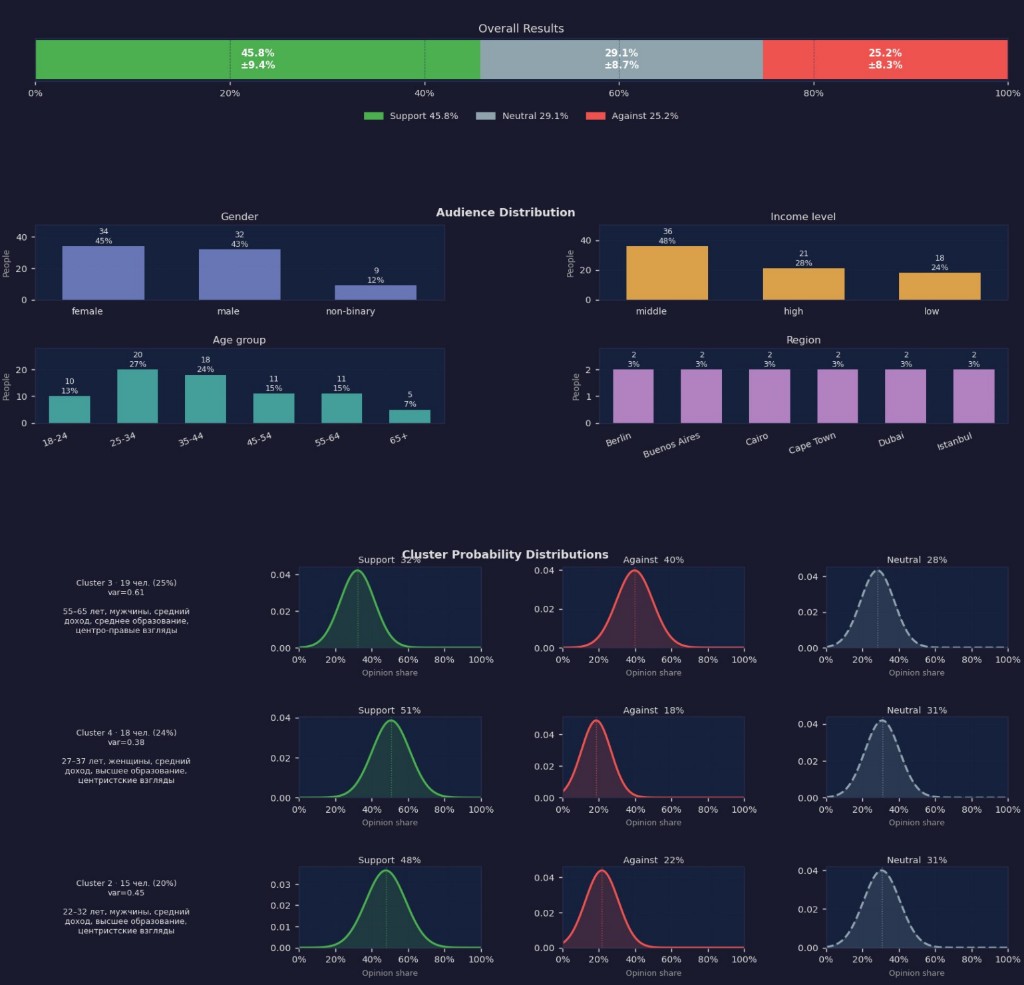
The simulated audience included:
The platform analyzed both emotional and rational responses to product positioning and pricing.
Positive Associations
Negative Associations
“The branding feels premium and visually appealing, but I would like to better understand why this product costs more than alternatives in the category.”
“I associate the design with higher quality, although the messaging still feels slightly generic.”
Tell us about your team and what you want to validate — we’ll follow up shortly.